This guide explains how ad formats are negotiated between the SSP and your DSP on every bid request, and which formats are available in which contexts.
Request types: contextual vs opener
Every bid request includes a request_type field. It tells your DSP what kind of impression you’re bidding on:
request_type | When it fires | What you receive | Response requirement |
|---|
contextual | In-chat — after the user has started a conversation. The ad is inserted between turns. | chatId, full messages history, nAdsBefore, plus geo + config. | ad_data optional. If omitted, the SSP calls your /render-ad endpoint after the auction. |
opener | Pre-chat — before the user has typed anything. The ad sits at the entry point of the chat surface. | No chatId or messages (no conversation exists yet). Just userId, geo, and config. | ad_data required. The SSP does not call /render-ad on opener bids — inline the creative or the bid is dropped with no_bid_reason=opener_missing_ad_data. |
contextual is the default if request_type is omitted.
Opener bids must include pre-rendered ad_data. The opener latency budget is tight and there is no render round-trip. Any opener bid response that omits ad_data is treated as a no-bid, even if the bid price would have won — a runner-up that inlined ad_data wins instead. If your DSP can’t pre-render within the opener timeout, return no-bid ({"data": {}}) rather than bidding.
ad_formats array — the list of formats the publisher can render for this specific impression:
{
  "ad_formats": ["sponsored_message", "sponsored_carousel"]
}
ad_data.ad_format (when pre-rendering) or in the render response via data.ad_format (when responding to /render-ad).
Two scenarios:
- One format offered (most common today, e.g.
["sponsored_message"]) — you must use that one. There’s no choice.
- Multiple formats offered (e.g.
["sponsored_message", "sponsored_carousel"]) — you may pick whichever you can fulfil best. If your bid for sponsored_carousel is stronger (better creative, more relevant catalog), pick it. If you don’t have ≥3 same-brand products with images, fall back to sponsored_message.
If you omit ad_format in your response, the SSP assumes "sponsored_message". Only set ad_format explicitly when returning a non-default format (e.g. "sponsored_carousel"). This keeps the simple case simple.
request_type | Allowed ad_formats values |
|---|
contextual | sponsored_message, sponsored_carousel |
opener | sponsored_message, sponsored_carousel |
opener requests, remember that ad_data must be inlined in the bid response regardless of format — there is no render round-trip.
A single-card ad with headline, description, CTA, and either a hero product image or an advertiser logo. This is the default ad_format — omit the field in responses to use it.
Your DSP declares how the card should render via a required placement field:
placement | Required URL | Render |
|---|
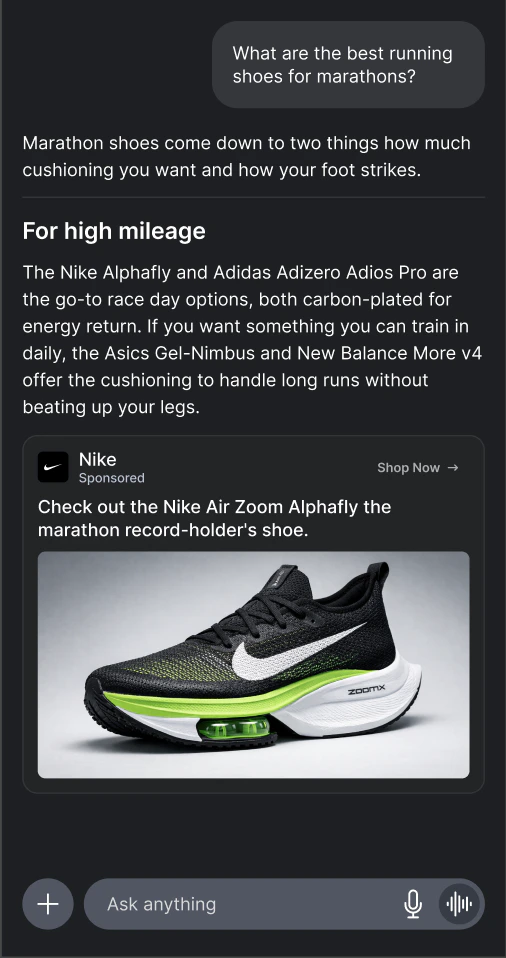
"image" | image_url | Full card with a hero product image (logo optional, shown as a small brand mark). |
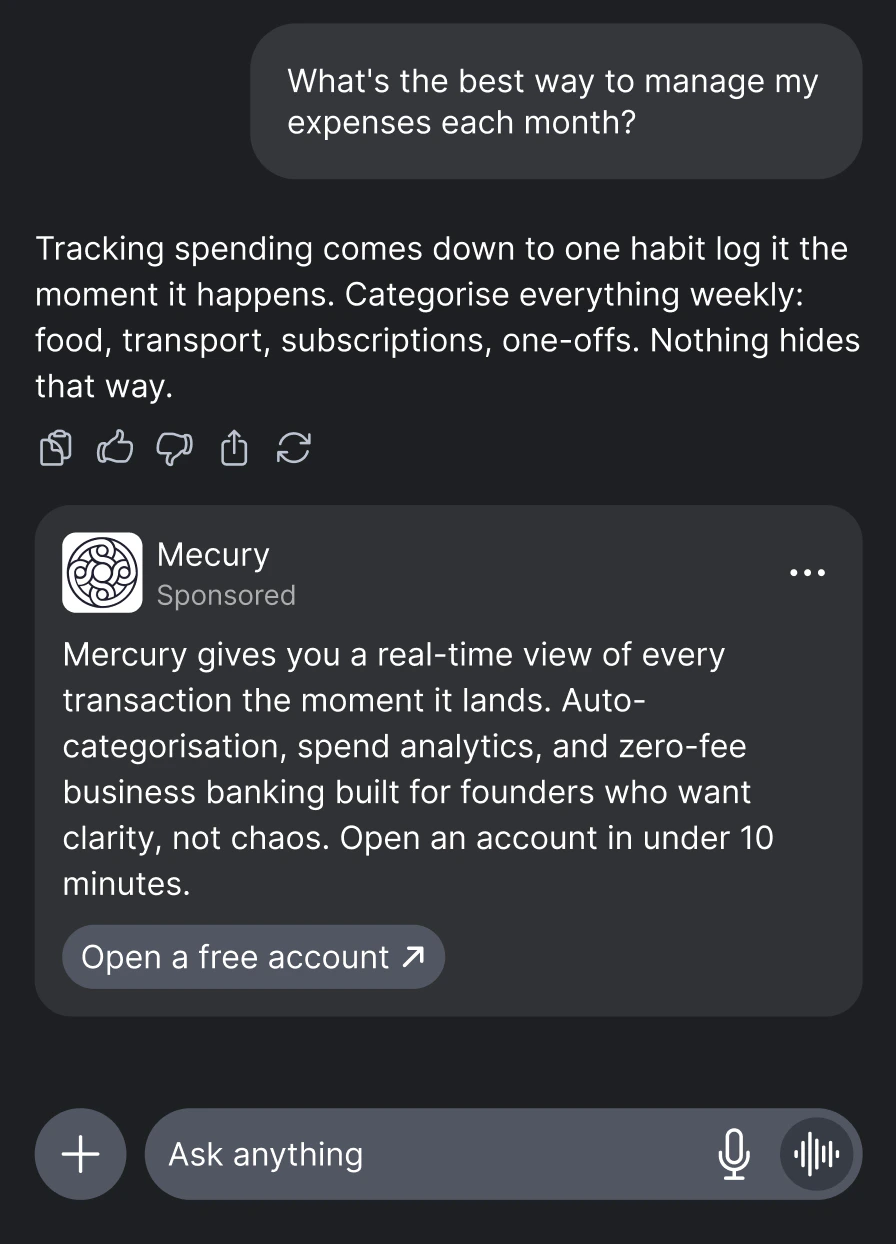
"text" | logo_url | Compact card with advertiser logo + copy. No hero image. |
placement, headline, url, advertiser, cta_text. description, domain, view_url are optional.
placement is required. Bids that omit it are rejected (dsp_missing_placement), unless your DSP is grandfathered during migration. Bids that declare placement="image" without image_url, or placement="text" without logo_url, are also rejected (dsp_invalid_image_bid / dsp_invalid_text_bid). The SSP does not guess — pick the mode your creative fits and populate the matching field.
placement="image" — hero product image
Use when you have a real product photo. image_url is required; logo_url is optional and recommended (the publisher may render it as a small brand mark next to the image).
Example response:
{
  "data": {
    "bid": 7.50,
    "bidId": "bid_abc123",
    "ad_data": {
      "ad_format": "sponsored_message",
      "placement": "image",
      "advertiser": "Nike",
      "domain": "nike.com",
      "headline": "Check out the Nike Air Zoom Alphafly",
      "description": "The marathon record-holder's shoe.",
      "cta_text": "Shop Now",
      "url": "https://example.com/track/click/abc123",
      "image_url": "https://cdn.nike.com/alphafly.png",
      "logo_url": "https://cdn.nike.com/logo.png",
      "view_url": "https://example.com/track/view/abc123"
    }
  }
}
placement="text" — compact logo card
Use when you don’t have a real product image — for example, brand awareness creatives, or when the product catalogue only has logo-style assets. logo_url is required; image_url is ignored if sent.
Example response:
{
  "data": {
    "bid": 7.50,
    "bidId": "bid_abc123",
    "ad_data": {
      "ad_format": "sponsored_message",
      "placement": "text",
      "advertiser": "Acme Sports",
      "domain": "acmesports.com",
      "headline": "Best running shoes 2026",
      "description": "Get 20% off premium running shoes today.",
      "cta_text": "Shop Now",
      "url": "https://example.com/track/click/abc123",
      "logo_url": "https://cdn.acmesports.com/logo.png",
      "view_url": "https://example.com/track/view/abc123"
    }
  }
}
Beta. Carousel is in early release. Upcoming improvements: mixed-brand carousels (multiple advertisers per carousel) and per-tile viewability tracking (which tile was actually viewed vs only rendered). The same-brand and single-view_url constraints below will be relaxed in a future version.
- Exactly 3 tiles (no more, no less).
- All tiles from the same brand — cross-brand carousels are rejected.
advertiser and domain required at the carousel level — shared across all 3 tiles.- Per-tile required fields:
tile_position (0/1/2), product_id, product_name, headline, image_url, url, cta_text. All mandatory on every tile.
- Per-tile unique
url — required so click attribution can identify which tile was clicked.
- Single bundled bid price — you bid once for the whole carousel; the publisher gets all 3 tiles for that price.
- Single
view_url — one impression pixel for the whole carousel, not per tile.
Example response:
{
  "data": {
    "bid": 7.50,
    "bidId": "bid_abc123",
    "ad_data": {
      "ad_format": "sponsored_carousel",
      "advertiser": "Acme Sports",
      "domain": "acmesports.com",
      "logo_url": "https://cdn.example.com/logo.png",
      "items": [
        {
          "tile_position": 0,
          "product_id": "sku_peg5",
          "product_name": "Pegasus Trail 5",
          "headline": "Cushioned trail runner",
          "image_url": "https://cdn.example.com/p1.png",
          "url": "https://example.com/track/click/abc123?tile=0",
          "cta_text": "Shop Now"
        },
        {
          "tile_position": 1,
          "product_id": "sku_vom17",
          "product_name": "Vomero 17",
          "headline": "Max cushion, daily miles",
          "image_url": "https://cdn.example.com/p2.png",
          "url": "https://example.com/track/click/abc123?tile=1",
          "cta_text": "Shop Now"
        },
        {
          "tile_position": 2,
          "product_id": "sku_inv3",
          "product_name": "Invincible 3",
          "headline": "Soft, bouncy ride",
          "image_url": "https://cdn.example.com/p3.png",
          "url": "https://example.com/track/click/abc123?tile=2",
          "cta_text": "Shop Now"
        }
      ],
      "view_url": "https://example.com/track/view/abc123"
    }
  }
}
sponsored_message.